
Streamlined Localization and Local Plus Relocation Policies: Tailoring Your Global Policies for Success

InterLink manages expatriate localization as a structured transition from international assignment status to local employment—ensuring alignment with organizational policy, cost objectives, and long-term workforce strategy.
Our team guides each phase of the process, from evaluating compensation and benefits alignment to coordinating tax, payroll, and immigration considerations. Through disciplined program management and real-time visibility, we help organizations reduce financial exposure, maintain compliance, and deliver a consistent employee experience throughout the transition.
We work with clients to design and implement localization provisions within their international assignment management framework—defining how assignment-related allowances are phased out, establishing clear transition timelines, and identifying any additional services required for employees remaining in the host location. The result is a controlled, transparent process that minimizes disruption, mitigates risk, and supports successful long-term integration.
Compensation packages for international assignees are becoming more complex and challenging due to exchange rate fluctuations, inflation, variable income tax rates along with compensation practices.
Creating experiences comparable to locally hired employees: The localization process takes the employee from an assignee status to a local employment status for pay and benefits; comprised of a compensation package (base salary, incentives, allowances, perks, social security, benefits, and retirement plans) that is comparable to what is offered to locally hired employees. This is an area with the most challenge to overcome any disparity between the expatriate and those working beside them who were locally hired.
Cost effectiveness: A question asked by Clients is, “How can we cost-effectively localize our expatriates and still make it a positive experience?” InterLink’s team of global experts works with Companies to answer this question.
One approach is to provide a broad localization policy that describes in a general sense what localization benefit categories can be included if the decision to localize is made and agreed upon. The individual’s benefits would be governed by a local offer letter that describes the specific terms and benefits that will be offered to ease the transition from assignee or local employee status.
Delayed Localization is another approach that is determined at the onset of the assignment. This is where the employee knows that after a specific period of time, 2 years for example, the assignment benefits will be phased out so that they soft-land into the location and ease the transition to a local employment status with local compensation and benefits, relieving the Company from on-going assignment-related expenses and obligation to repatriate the employee to their home country.


A Local Plus is another relocation method for Companies to localize employees with flexibility. This type of policy seeks to provide a competitive compensation package that is not typically offered to local hires to secure the sought-after talent needed. A Local Plus policy can be used for localization or instead of a standard cross-border relocation package. It allows for the flexibility needed to highly personalize a package for the individual and location.
Packages typically includes additional assistance such as:
InterLink recognizes technology-enabled support is a key expectation in a full-service mobility management suite GlobalLink® is not only a web-based client tool to activate a move but is a safe and secure system with robust reporting capabilities
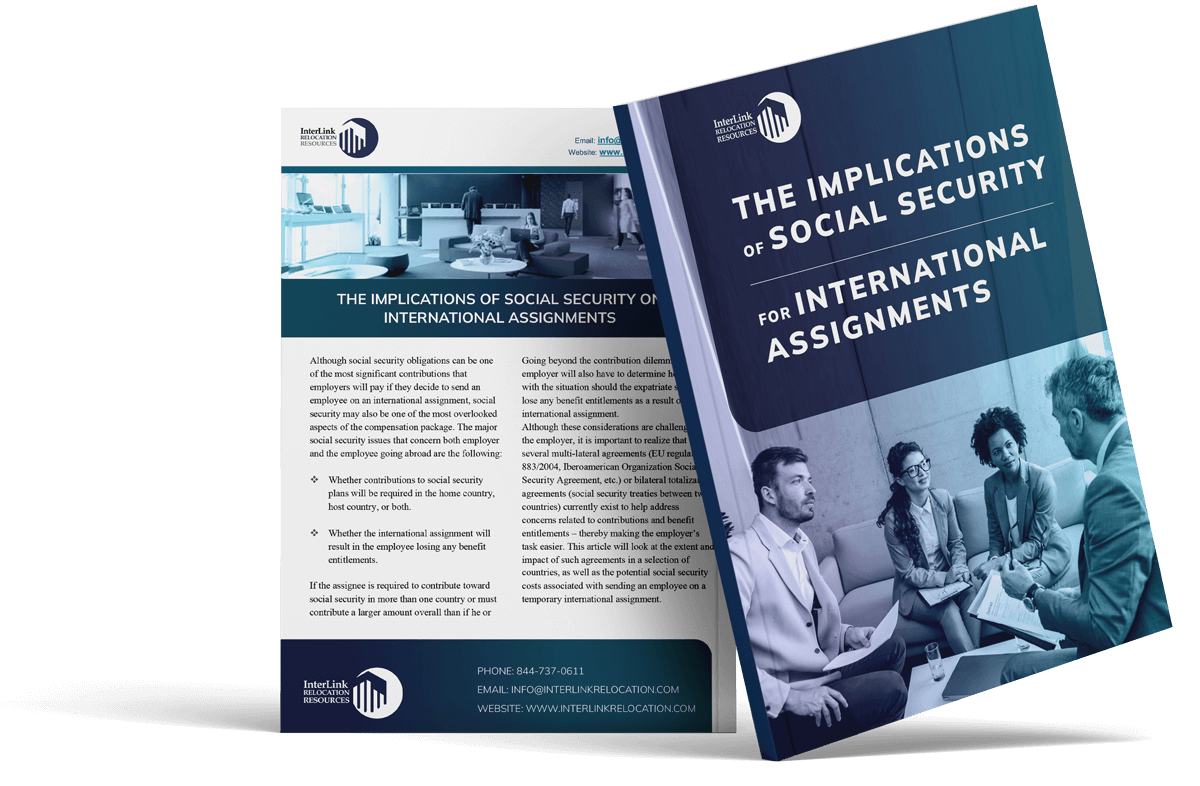
Free White Paper
International assignments must not overlook the significant impact of social security obligations to avoid issues with employer contributions and compensation. Addressing these obligations carefully is essential for a smooth and compliant assignment experience for employers and employees.
Relocation is complex and stressful, but it doesn’t have to be! Reach out and we’ll be in touch to schedule a 15 min, no-obligation conversation to hear more about your company relocation needs.

Once they understand what’s involved, InterLink develops the best solutions for the company and the employees, minimizing stress for everyone.”
The outcome has been an excellent alignment between the company’s needs and those relocating. We are happy to be part of the InterLink ‘family’. More importantly, so do our employees”
They always went above and beyond to understand our needs to provide guidance and to find the right third parties to work with. I would highly recommend other companies to use Interlink Relocation Resources.”
Whether your current policies are years old, or you’ve never established them at all, ineffective relocation plans can dramatically hurt your business through lost income and talent.
Get a Free Assessment
A new California law effective January 1, 2026, will significantly restrict employee repayment agreements tied to relocation, training, and other employment-related costs. For HR, mobility, and talent leaders, this has direct implications for relocation policies, global mobility programs, and risk management. InterLink's latest white paper outlines what AB 692 means—and why now is the time to review repayment language before it creates compliance exposure.
DOWNLOAD WHITE PAPER
Meet Scott Addaman from InterLink in Nashville at the April 23rd Tennessee Relocation Council Spring Conference! The Tennessee Relocation Council (TRC) Spring Conference brings mobility professionals together for education, collaboration, […]
VIEW EVENT INFO




 Search